In the realm of modern manufacturing, the five – axis machining center stands out as a technological marvel. As a supplier of five – axis machining centers, I’ve witnessed firsthand the transformative impact these machines have on various industries, particularly in achieving multi – sided machining with unparalleled efficiency and precision. This blog delves into the mechanisms by which a five – axis machining center accomplishes multi – sided machining, explores its benefits, and showcases its real – world applications. Five-axis Machining Center
Understanding the Basics of a Five – Axis Machining Center
Before we can understand how a five – axis machining center achieves multi – sided machining, it’s essential to grasp the fundamental concept of the five – axis system. Unlike traditional three – axis machining centers that operate along the X, Y, and Z linear axes, a five – axis machining center adds two additional rotational axes. These rotational axes are typically denoted as A and B or A and C, where the A – axis rotates around the X – axis, and the B – or C – axis rotates around the Y – or Z – axis, respectively.
This additional rotational freedom allows the cutting tool to approach the workpiece from virtually any angle. In a multi – sided machining operation, this means that complex parts with various surfaces and features can be machined without the need for multiple setups and re – clamping. This not only reduces production time but also minimizes errors that may occur during the re – positioning process.
The Process of Multi – Sided Machining in a Five – Axis Machining Center
1. Workpiece Alignment and Fixturing
The first step in multi – sided machining is properly aligning and fixturing the workpiece. Special fixtures are designed to hold the workpiece securely while allowing for the necessary rotational movements. These fixtures need to be precisely calibrated to ensure that the workpiece is positioned correctly relative to the machine’s axes.
2. Toolpath Planning
Once the workpiece is fixed, the next crucial step is toolpath planning. This involves using computer – aided manufacturing (CAM) software to generate a set of instructions that dictate how the cutting tool will move across the workpiece. In multi – sided machining, the CAM software takes into account the additional rotational axes, calculating the optimal toolpaths to reach all sides of the workpiece. The software considers factors such as the cutting tool’s geometry, the material properties of the workpiece, and the desired surface finish.
3. Simultaneous Motion Control
One of the key features of a five – axis machining center in multi – sided machining is the ability to control the movement of all five axes simultaneously. The machine’s control system coordinates the linear and rotational movements of the axes to ensure that the cutting tool maintains the correct orientation and position relative to the workpiece at all times.
For example, as the tool moves along the X, Y, and Z axes to machine a particular surface, the A and B (or C) axes can rotate to present the next surface for machining. This simultaneous motion control allows for continuous machining of multiple sides of the workpiece in a single operation.
4. Adaptive Machining
During the machining process, the five – axis machining center can adjust its operations in real – time. Sensors built into the machine monitor parameters such as cutting forces, temperature, and tool wear. If any deviations from the optimal conditions are detected, the control system can automatically adjust the feed rate, spindle speed, or toolpath to ensure consistent quality and prevent damage to the workpiece or the tool.
Benefits of Multi – Sided Machining with a Five – Axis Machining Center
1. Time Savings
The ability to machine multiple sides of a workpiece in a single setup significantly reduces production time. Traditional machining methods often require multiple setups and transfers between different machines, which can be time – consuming. With a five – axis machining center, parts can be completed much faster, increasing overall productivity.
2. Improved Accuracy
By minimizing the number of setups, the chances of errors due to re – clamping and re – positioning are greatly reduced. This leads to higher accuracy and better tolerances in the machined parts. The continuous motion control and real – time adjustments also contribute to maintaining a high level of precision throughout the machining process.
3. Enhanced Surface Finish
The five – axis machining center can approach the workpiece from the most favorable angles, allowing for smoother cuts and better surface finishes. This is especially important for parts that require a high – quality surface, such as aerospace components and medical devices.
4. Complex Part Machining
Multi – sided machining with a five – axis machining center enables the production of highly complex parts that would be difficult or impossible to manufacture using traditional methods. The additional rotational axes allow for the machining of undercuts, compound angles, and intricate geometries.
Real – World Applications of Multi – Sided Machining
1. Aerospace Industry
In the aerospace industry, the production of components such as turbine blades, engine casings, and structural parts requires high precision and the ability to machine complex shapes. Five – axis machining centers are widely used to manufacture these parts, as they can achieve the tight tolerances and smooth surface finishes required for optimal performance.
2. Automotive Industry
The automotive industry benefits from multi – sided machining for the production of engine blocks, transmission components, and custom – designed parts. The use of five – axis machining centers allows for the efficient production of high – quality parts with reduced lead times.
3. Medical Industry
Medical device manufacturers rely on five – axis machining centers to produce complex surgical instruments, implants, and prosthetics. The ability to machine parts with high precision and excellent surface finish is crucial in the medical field to ensure the safety and effectiveness of these products.
Conclusion

As a supplier of five – axis machining centers, I am constantly impressed by the capabilities of these machines in achieving multi – sided machining. The integration of linear and rotational axes, combined with advanced control systems and CAM software, enables the production of highly complex parts with exceptional accuracy and efficiency.
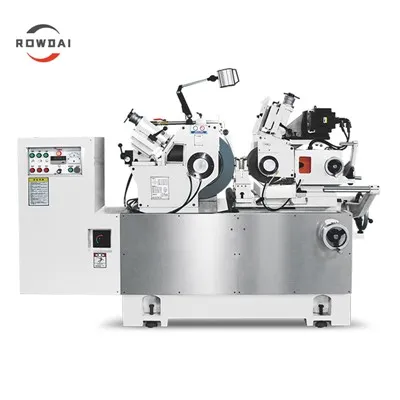
Cylindrical Grinding Machine If you are in an industry that requires high – precision machining of multi – sided parts, our five – axis machining centers could be the solution you’ve been looking for. We are committed to providing top – notch machines, along with comprehensive technical support and training. Contact us to discuss your specific requirements and explore how our five – axis machining centers can enhance your manufacturing processes.
References
- Groover, M. P. (2010). Fundamentals of Modern Manufacturing: Materials, Processes, and Systems. Wiley.
- Dombovy, R. L., & Tobias, S. A. (1985). Machine Tool Structures: Volume 1, Static and Dynamic Principles. Cambridge University Press.
Henan Rowdai Machinery Equipment Co., Ltd.
As one of the most professional five-axis machining center manufacturers in China, we’re featured by quality products and good price. Please rest assured to buy high-grade five-axis machining center for sale here from our factory. If you have any enquiry about cooperation, please feel free to email us.
Address: Building 9, E-Commerce Industrial Park, High-Tech Zone, Zhengzhou, Henan, China
E-mail: rowdai@rowdai.com
WebSite: https://www.rowdai.com/
